Posed similar questions about communism in the past. I’m just trying to understand, I ask because I know there is a reasonable contingent of anarchists here. If you have any literature to recommend I’d love to hear about it. My current understanding is, destruction of current system of government (violently or otherwise) followed by abolition of all law. Following this, small communities of like minded individuals form and cooperate to solve food, safety, water and shelter concerns.
As I understand it, anarchism is less about eliminating laws and more about eliminating hierarchy. It’s bottom-up governance that requires lots of participation from everyone involved. You and your peers can establish laws for your neighborhood/town/etc., but everyone affected by that law needs to directly participate in its writing and there must be broad consensus before it is enacted. Law enforcement must be communal; you cannot outsource it to a police force, lest the police become oppressive.
When I think of anarchism I sometimes think of colonial New England: small towns that are largely autonomous, where communal decisions are made at town hall meetings and the locals manage themselves. It’s not a perfect analogy since there were higher levels of government, but day-to-day governance was very grass-roots.
That makes sense, funny you bring up colonial New England making communal decisions. Makes me think about the witch trials right away lol. Guess there wouldn’t really be checks/balances stopping that kind of thing, youd just move to a different place if you didnt like it?
If we learned anything from 2025 it’s that checks and balances only work when a critical mass of people agree to them. One of the US’s major political parties has abandoned rule of law and sent ICE on a modern day witch hunt against immigrants and perceived enemies. If you don’t like it, time to move. An anarchist would say this situation is a great example of why we shouldn’t outsource governance to entities that have power over us.
Thats a pretty fantastic point.
There also are Zapatistas who are currently anarchists (they don’t describe themselves as such though)
Check out The Conquest of Bread by Kropotkin. It’s an easy read, I had no trouble with it in high school. It doesn’t need to be violent at all. Very much a “From each according to his ability, to each according to his need” kind of book. People focus a lot on “Why should that person have what I have, when I worked so hard?” when the real question is “Why should that person go without what all of us have, when it’s completely unnecessary?”
I’ll look into it, thanks!
I can also recommend Anarchy Works by Peter Gelderloos.
Thanks!
I don’t know but there would probably be trains.
That’s Autism, not anarchism
The co-occurrence is surprisingly high
Less surprising the more you know about autism, really
It’s a spectrum.
The spectrum:
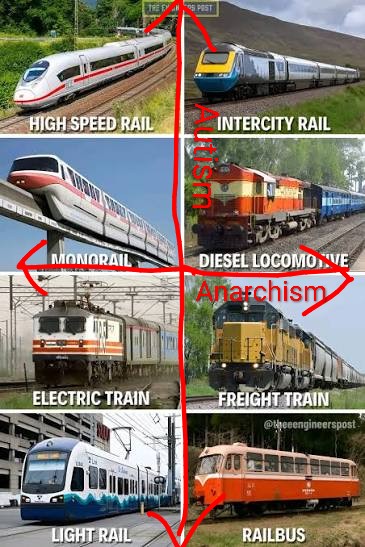
Me and my homies:

Not an anarchist, but the common thread among those I’ve talked to is the elimination of hierarchical structures (whether government or otherwise).
Other types of organization are fine, as long as there are no asymmetric institutional relationships.
I’d be interested to figure out what type of organization are compatible.
Cooperatives, mutual aid networks like Food Not Bombs, rank-and-file/leaderless unions like the IWW, etc. There is a limited number of modern day examples because such organizations have historically faced systematic repression, but the list grows much longer if we look to the past. Such organization also tends to form spontaneously during natural disasters and the like when there is little to no state intervention, and quickly dissolve whenever the state intervenes.
For organizations with broader scope and on longer timescales, the Zapatistas in Chiapas, Mexico and Rojava in north and east Syria are good examples.
Keep in mind of course that the real world is messy and full of conflict, and that results in there not being any perfectly pure example of anarchist ideals in practice in the same way that there is no perfectly pure example of any ideology in practice. In addition, many of the groups I listed above do not make explicit reference to anarchism and are doing their own thing that just so happens to map onto anarchist ideas, and they often don’t call themselves anarchist or even have an aversion to ideological labels entirely.
Super interesting!
Anarchism is essential education, but highly impractical. It works on a fictional premise of good faith actors internally, while not maximizing power for threats externally. Because neither of these conditions are met, Anarchism remains relegated to ephemeral pop-ups and subsequent collapses. I wish it didn’t have to be so, it is a noble system.
Except it takes “faith in good faith actors” to want to invest some with power.
No it doesn’t. Plenty of people do it out of fear or even laziness.
https://anarwiki.org/wiki/List_of_Anarchist_Societies
This might be of interest.
I love that list of examples, because they’re either not anarchist, or are very limited communes that function because of (and under the laws of) the larger democratic governments around them. Or they don’t exist anymore
Yes, that’s generally the caveat.
Anarchism works really well in groups where everyone knows everyone else personally, the community is protected from outside attacks by a non-anarchist superstructure, and everyone is free to leave if they don’t like it.
You can have an anarchist commune, village or town, but not an anarchist nation-state surrounded by other nation-states.I’d even claim that small homogeneous communities naturally gravitate towards anarchism (without outside force), but large communities naturally gravitate towards authoritarianism.
Democracy in its ideal form combines the two: A state with well-defined, legitimized, limited authority handling the big stuff, giving the maximum amount of freedom possible to local communities for handling their own stuff the way they want to.
Thats pretty cool, thanks!
Not very well. At least not for large communities, or ones that want to live modern lives in the developed world.
Yes it’s quite possible to have small communities where everyone knows each other, then you can enforce rules through consensus and social pressure.
But it would be impossible to have large societies or to live in a modern developed world with no hierarchical structures.
There’s a lot of unsaid assumptions going on here. If you’re talking about turning our society completely without any preparation, I’d agree. If you’re talking about having similar levels of healthcare or I strongly disagree
Thats kind of what I’d assume but I’ve never talked about it with someone knowledgeable.
Not very well. At least not for large communities, or ones that want to live modern lives in the developed world.
Yes it’s quite possible to have small communities where everyone knows each other, then you can enforce rules through consensus and social pressure.
Wouldn’t viewing a large community as a federation of small ones solve the problem? Federations pop up when needed. When they don’t reach consensus, they break up into smaller parts, some of which give the idea a try?
Seems very natural to me, similar to how open source repositories interconnect. People collaborating, differing of opinion, forking or restarting.
Anarchism generally holds that nobody is superior to another. Society then functions because everyone recognises good ideas and will just cooperate to do them, and because everyone will be thusly motivated, nobody will want anything they can’t receive.
Modern western society is already founded on the belief that nobody is inherently superior to anyone else. Now of course in practice this has not always been the case, and there still exist a lot of people who really don’t believe this is true. But the ethos is still there, and most people would tell you they believe in it.
To continue that, and to your second point, one of the biggest flaws in any system we create is that humans are not perfectly logical and rational actors. You can’t count on everyone always doing the right thing, even if they could all agree what “right” even means.
Yeah, the holes are pretty damned obvious. Anarchism really only exists in the complete absence of stressors.
everyone recognises good ideas
It is like communism, it would work perfectly well if everyone was smart and reasonable and had the same goal.
Every system of government would work when everyone was smart and reasonable and had the same goals.
Any social and community structure is successful or not depending on how it handles those that want to abuse or undermine the system.
deleted by creator
True anarchy would not be possible until every human being on the planet is on the same page and doesn’t hate another for stupid reasons like what pronouns they want to be referred to by or what color their skin is, and also with zero absence of greed.
On the small scale, a co-op is basically anarchist. Nobody is really in charge, everyone pitches in. It works incredibly well small scale. The bigger the group, the more likely corruption will fuck everything up.
That seems to be my opinion.
It’s more of a philosophy than a system of governance. A government that follows anarchist ideals would not incarcerate people much, but would do a lot to make sure private individuals can’t attain much power over each other. It would be focused on preventing a tiered class system from forming and making sure people aren’t critically dependent on a single employer.
Seems possible if we were creating new colonies on other worlds or something. I feel like you’d really have to start fresh with a group thats all on the same page. I don’t see how it could be implemented in current state capitalist countries. But, like I said, thats how I feel not necessarily the reality of the situation.
I think if you’re asking questions about communism and anarchism, it makes most sense to ask those questions where communists and anarchists hang out, rather than communities that tend to be more liberal. For clarity, I’m a Marxis-Leninist that used to be an anarchist.
Anarchism is primarily about communalization and decentralization of production and distribution. Anarchists view the state as a monopoly on violence and an unjustifiable hierarchy, and so seek to establish horizontalist structures and production methods that are more local than interconnected where possible. Think community self-reliance, with minor trade between cells.
An Anarchist FAQ tends to be valued among anarchists as a good but lengthy intro.
TIL: anarchy is Agile
I appreciate the faq! This group has the highest concentration of communists/anarchists I’ve found. The blend of other ideologies here is helpful too because I want to hear/understand dissenting opinions from those who have studied it as well.
No problem on the FAQ! It’s a deceptive title, it’s extremely lengthy. I don’t really agree with it either, as I’m a Marxist, not an anarchist, but I know anarchists swear by it.
As for what I mean by asking in a place with more anarchists and communists, Lemmy.world is predominantly liberal. The communists are usually on Lemmygrad.ml, Hexbear.net, or Lemmy.ml, while the anarchists are generally on dbzer0 and Hexbear.net.
With a Lemmy.world account, on a Lemmy.world community, you are going to find the majority of upvoted comments are from non-communists trying to explain communism. For example, the top comment that showed up for me on the communism post was entirely off-base, to which I wrote a hopefully constructive response. These kinds of comments are upvoted on Lemmy.world because they reinforce the general “pro-left in theory, anti-left in practice” stance that is predominent here on Lemmy.world.
I think it’s useful for getting the ideas of non-communists, ie you have your dissenting opinions, but for a more well-rounded view I’d use Lemmy.ml’s Ask Lemmy community and with a Lemmy.ml account, as that way you can actually see Hexbear.net and Lemmygrad.ml answers. Just my two cents!
Marxist and Anarchist spaces online tend to be the biggest echo chambers on the internet. I think people like OP would get more valuable information in a more open space like this than over there
anarchism isn’t a system. it’s a guiding principle.
That’s about correct. You miss the final stage: rise of a group of leaders, who quickly manipulate the other members, take over power and (in the absence of law) create a dictatorship.
Y’know, given… gestures vaguely, I think that’s not an anarchism problem.
How would anarchism work
That’s the neat part, it doesn’t work
Anarchism is a bit of a fantasy once it encounters reality, like most political ideologies. The most viable attempt at an anarcho-government was in spain before Franco. It failed in terms of running a functional country, with the short lived experiment being unable to even decide whether to arm the few defenders against Franco’s authoritarian capture of the country – Durruti had to basically raid/steal weapons for his troops to mount any kind of resistance.
So literature I’d recommend is basically spanish history.