You must log in or # to comment.
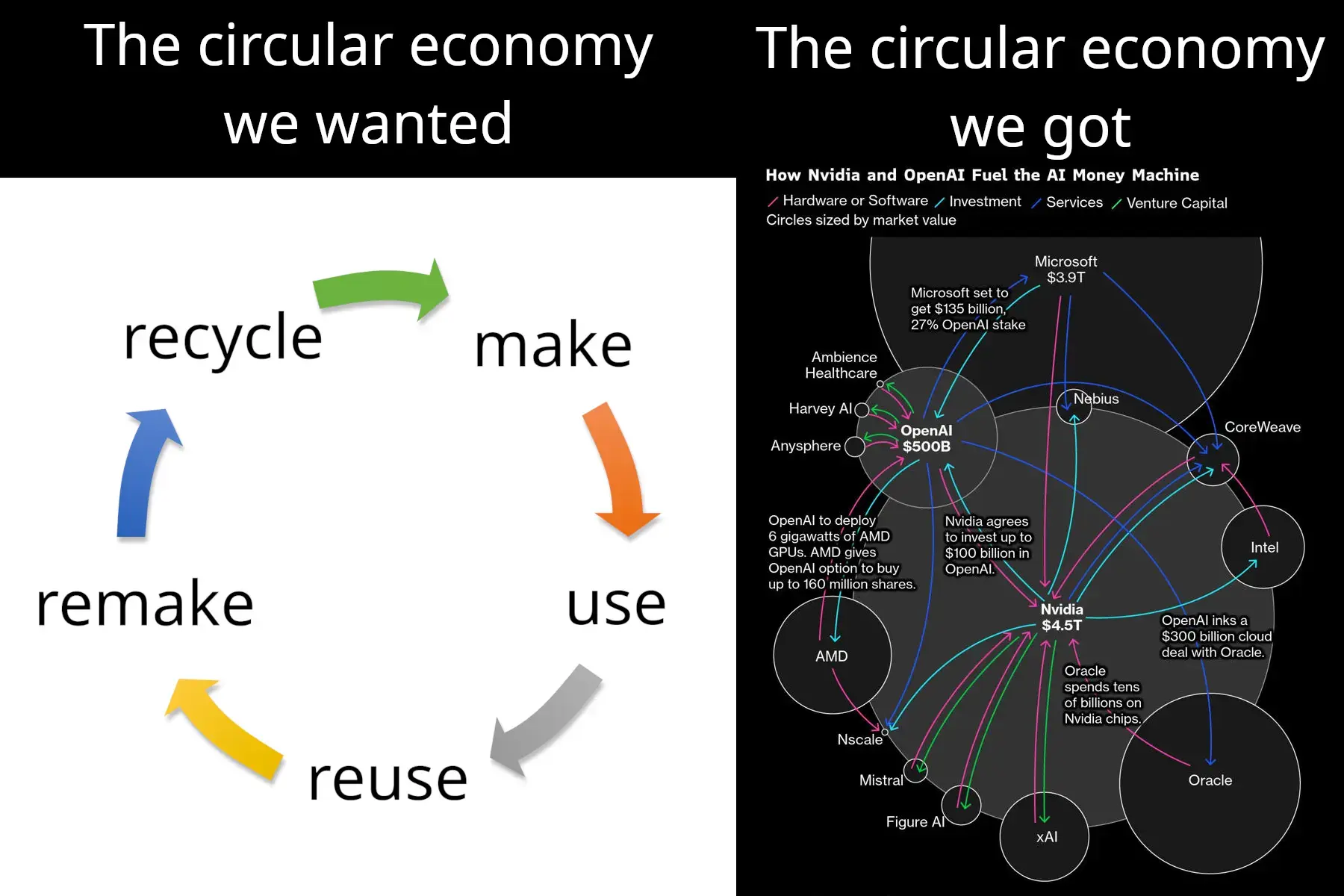
sustainable vs unsustainable
You SIGN a contract, you don’t fucking INK it. Sorry, that pisses me off to an irrational degree, everything else about the meme is correct. Everyone return to work.
Metaphors are some of the most human things. “Oh, I’m tired of saying this in the normal way, let me say it in a slightly different way that nonetheless people will understand because of community and shared experience!” Eventually it becomes a thing that people just accept as normal, and it becomes an actual linguistic element or word.
Actually, an argument could me made that that’s the only way words happen; for instance, the word “sign” itself started as a metaphor. It was originally the Latin word “signum,” referring to a military banner; it passed into French as “signe,” and took on the meaning “mark that proves authority,” and by the time it made it to English, it meant “putting my mark on something in a way that makes it real.” We’re witnessing that same process happening with “ink” (used to mean “sign”) right now.
So maybe you’d feel better about it if you thought of us as being in the middle of the etymology of “ink.”
Doesn’t inking something mean you write it in ink? As in create the contract? I’d think that’s slightly different than signing.
Also, both sound just fine when it’s about a contract that was definitely both created and signed by the cited entities.
I think it’s usable for both the signing of a contract as well as the combined act of drafting and signing. Usually the sense of “creating” a legal document without signing it is referred to as “drafting” or “drawing up” the contract; I don’t think I’ve ever heard “inking” used in that sense.
You write it in ink, yes; but you also sign it in ink. That’s the more definitive and final action, and represents when a thing actually occurs.
For instance, a football player can “ink” a contract to play for a team; this is almost certainly meant in the “signed” sense, as the team almost certainly wrote it. And two companies can “ink” a contract to work together or merge or whatever, and almost certainly that contract was both written and signed by those companies’ representatives. But a lawyer who wrote a contract (like a will) which someone else signed wouldn’t have “inked” it, but rather “drawn it up.”
Doesn’t inking something mean you write it in ink
It can, but it can also be used as a colloquialism for ANY way of entering a contract, even digitally (with your fingers 😉)
“fingering the contract”
Good points! This reminds me of a thought I had the other day: why do we use the word “novel” meaning “original, of a kind not seen before” to mean “a fictional written work on the order of hundreds of pages”? I’m sure there was a process behind that etymology. Someone could have made up a previously unused word, but novel words sound too silly to get people to repeat them. As an example consider the French Academy’s attempt to get people to say “courriel” because they didn’t like French speakers borrowing the English word “email”. Or probably more accurately: unless you’re speaking French in recent history, no one is in charge of words, and there is no plan.
Interesting question! I looked it up, and wow, it has a way weirder history than I thought.
The word comes from Latin, of course, and derives from the Latin “novus,” meaning “new” (and does indeed share a lineage with words like “supernova”).
Over time, Romans started to use “novella” (which is the diminutive plural of “novus,” so “little things that are new”) to refer to…well, items of news. Current events. “News,” incidentally, is the plural of “new,” so this shouldn’t be too surprising. (Side note: “novella” also has an agricultural meaning as a young shoot from a plant–it’s apparently still used today, in wineries–and I’ve seen some suggestion that that meaning is also a part of the etymology, but I haven’t seen it enough to really be confident with that.)
That meaning seems to have stayed fairly consistent for a long while, in that we didn’t really separate “fictional news” from “true news.” Fiction was only for the rich, anyway, and fictional stories were mostly called “romances” when they were called anything at all, referring to the fact that they were written romanice loqui–in vernacular Latin, in the language of the everyday Roman.
During the Middle Ages, a blurry line between truth and fiction led to using the term “novella” to mean “narratives,” whether real or imaginary, and especially when compiled into a collection. But in the mid-1300s, an Italian author named Giovanni Boccaccio published The Decameron, which was similar in both construction and literary impact to Chaucer’s Canterbury Tales, released just a few years later, and The One Thousand And One Nights, compiled centuries earlier. In Boccaccio’s book, Florentine plague survivors are hiding out in the countryside to escape the Black Death as it sweeps through Europe, and the ten of them each tell a story each day for ten days (hence, Deca-). Each of the hundred individual stories in The Decameron are called novella, and the book’s popularity led to the word “novella” being reinterpreted as “a fictional narrative” across Europe, supplanting the word “Romance” in most languages (which came to refer only to the love story that was at the core of a lot of chivalric tales). In French, the word was rendered “nouvelle,” which came into English as “novel.”
Another side note: even though “new” sounds like the beginning of “nouvelle,” while the two go back to the same Proto-Indo-European lemma, “new” comes to us by way of Germanic, not Latin. Ironically, the word “new” is pretty old; that PIE root is “néwos.”
But literacy (and printing) being what it was in the Middle Ages, the word “nouvelle” didn’t refer specifically to written stories until Cervantes. Don Quixote is widely considered to have been the first modern novel, and its release between 1605 and 1615 drew a dividing line between the “French” romance and the “Spanish” novel (from the same Latin root as “nouvelle,” but rendered in Spanish, of course), firmly defining the latter as a work of literature; at least in Spain. English novels likewise became written or printed stories in the mid-1700s, when novels like Defoe’s Robinson Crusoe and reprintings of Thomas More’s Utopia started to define the English novel. At that point, the French got into the game as well, with books like Voltaire’s Candide becoming a key part of the French Enlightenment. As literacy increased in Europe in the 18th century, the novel spread across the continent and codified the term.
unless you’re speaking French in recent history, no one is in charge of words, and there is no plan.
Absolutely! Prescriptivists are fighting a losing battle, as the Academie is refusing to learn.
Other fun side notes:
-
Some of the citizens of the last remnants of the Inca empire probably read Don Quixote, as it was published and immediately shipped to the Americas in hopes of finding a better price. The ship was lost, and about seventy copies made it to Cuzco!
-
The Decameron was subtitled “Prince Galehaut” (no relation to Galahad), a knight who was supposedly friendly with Sir Lancelot but an enemy of King Arthur; he is, it’s said, the one who introduced Lancelot to Guinevere, kicking off the affair that eventually tore down Camelot.
-
William Shakespeare’s All’s Well That Ends Well is an adaptation of Neifile’s novella from day three of The Decameron, about Giletta di Narbona.
-
Jonathan Swift likewise adapted a novella from The Decameron, as A Tale of a Tub in 1704. He also may have written Gulliver’s Travels to rebut Defoe’s Robinson Crusoe.
-
The use of “novel” as “new, atypical, unprecedented” also came from the Latin “Novellus,” but rather than going from Latin to Italian to French, it came to French directly from Latin.
-
Interesting! I would not have guessed that “novella” predated “novel”. But it seems that the modern English meaning of “novella” being a story with a length in between a novel and a short story is pretty different from the older Latin and Italian meanings. I’m going to imagine there was another process where “novella” picked up that specific meaning.
It happens I watched The Decameron series on Netflix recently, which was entertaining. I’m sure it’s very different from the original book - probably only sharing the setting, and some character names.
It’s interesting how it was kind of a return to the original definition of the word!
And I know almost nothing about The Decameron, except as a node in the story of the word “novel,” so I wouldn’t know. I’ll have to check it out!